
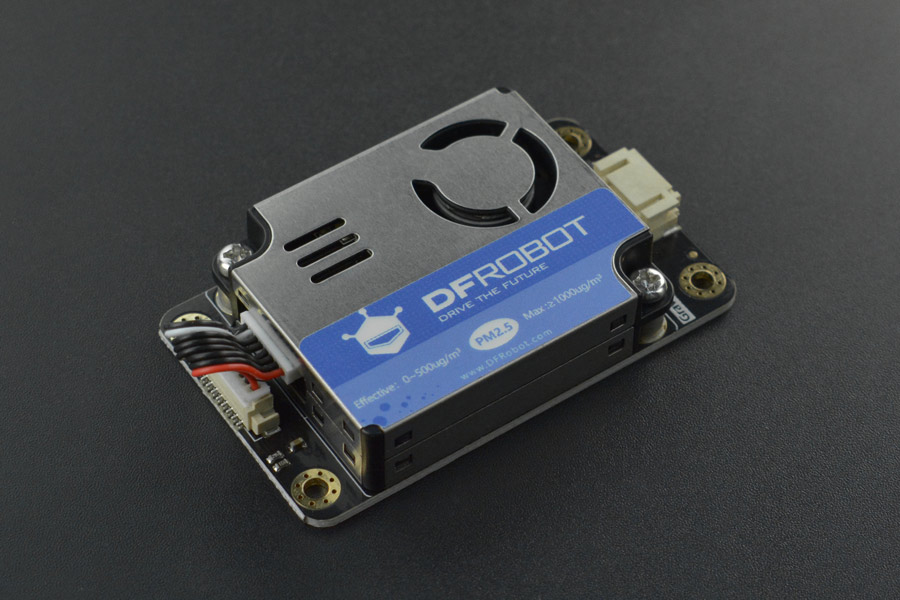
DFRobot Gravity: PM2.5 Air Quality Sensor

Ask Our AI Assistant

Product Image
Working Principle

Description

The DFRobot Gravity: PM2.5 Air Quality Sensor operates based on the laser scattering principle. This involves irradiating suspended particles in the air with a laser to cause scattering. The scattered light is collected at a specific angle, and the intensity of this scattered light is measured over time. A microprocessor then uses the MIE theory algorithm to calculate the equivalent particle size and the number of particles of various sizes per unit volume.

Sensor Types

Laser scattering

Dos And Donts

Donts

  • Expose To Extreme Conditions: Avoid using the sensor beyond the operating temperature range of -10 to +60°C and relative humidity range of 0 to 95%.,
  • Obstruct The Sensor: Ensure the sensor's laser and detection areas are not obstructed or covered to avoid inaccurate readings.

Dos

  • Use In Appropriate Environments: Ideal for environments like smoking rooms, kitchens, hot springs, and bathrooms where air quality monitoring is crucial.,
  • Follow Connection Guidelines: Ensure to use the Gravity-4P I2C/UART Sensor Cable provided for proper connection.,
  • Check Compatibility: Verify compatibility with main controllers as the sensor works well with most of them.
Limits

Environmental

  • Temperature Range: -10 to +60°C,
  • Humidity Range: 0 to 95% relative humidity

Measurement Capacity

  • Particle Size Range: 0.3 to 10μm,
  • Minimum Recognizable Particle Size: 0.3μm
How To Connect

Connection Steps

  • Description: Use the included Gravity-4P I2C/UART Sensor Cable to connect the PM2.5 Air Quality Sensor to your main controller. Refer to the connection diagram provided in the documentation for detailed setup instructions.
Dimensions

Sensor Dimensions

67mm (L) x 40mm (W) x 14mm (H)

Shipping Dimensions

8 × 6.5 × 2.5 cm

Shipping Weight

0.052 kg

Weight

30g